

In almost every workshop, training, and consulting session I run, the same picture surfaces. Someone describes an AI agent as a kind of synthetic employee: a worker who lives in the cloud, clocks in while you sleep, and performs the job about as well as a person. Maybe, they’ll add with a nervous laugh, even better.
It’s an understandable picture. It’s also the most expensive misconception in the room, because everything that follows from it is wrong. If you believe an agent is a synthetic person, you’ll hand it work nobody supervises, you’ll expect it to exercise judgment it doesn’t have, and you’ll assume it can be held accountable for outcomes it can’t own. That’s not an adoption strategy. That’s a liability waiting for a quarterly review.
So let’s replace the picture with something accurate.
What an agent actually is
An agent is not a synthetic human. It’s a system that takes a goal and works toward it in a loop. You give it an objective, and it chooses its own tools, takes a step, checks the result, takes another step, and keeps going until the job is done or it hits a wall. That loop, running without you steering each move, is the whole trick. It’s genuinely powerful. It is not a person, and the difference is not a technicality. It’s the entire point.
The reason the “synthetic employee” misconception spreads is that the word “agent” got stretched to cover everything. One person means a chatbot. Another means an automation. A third means the thing that files their expenses now. When a word means everything, it means nothing, and into that vacuum rushes the most human-shaped image available: a coworker who happens to be made of software.
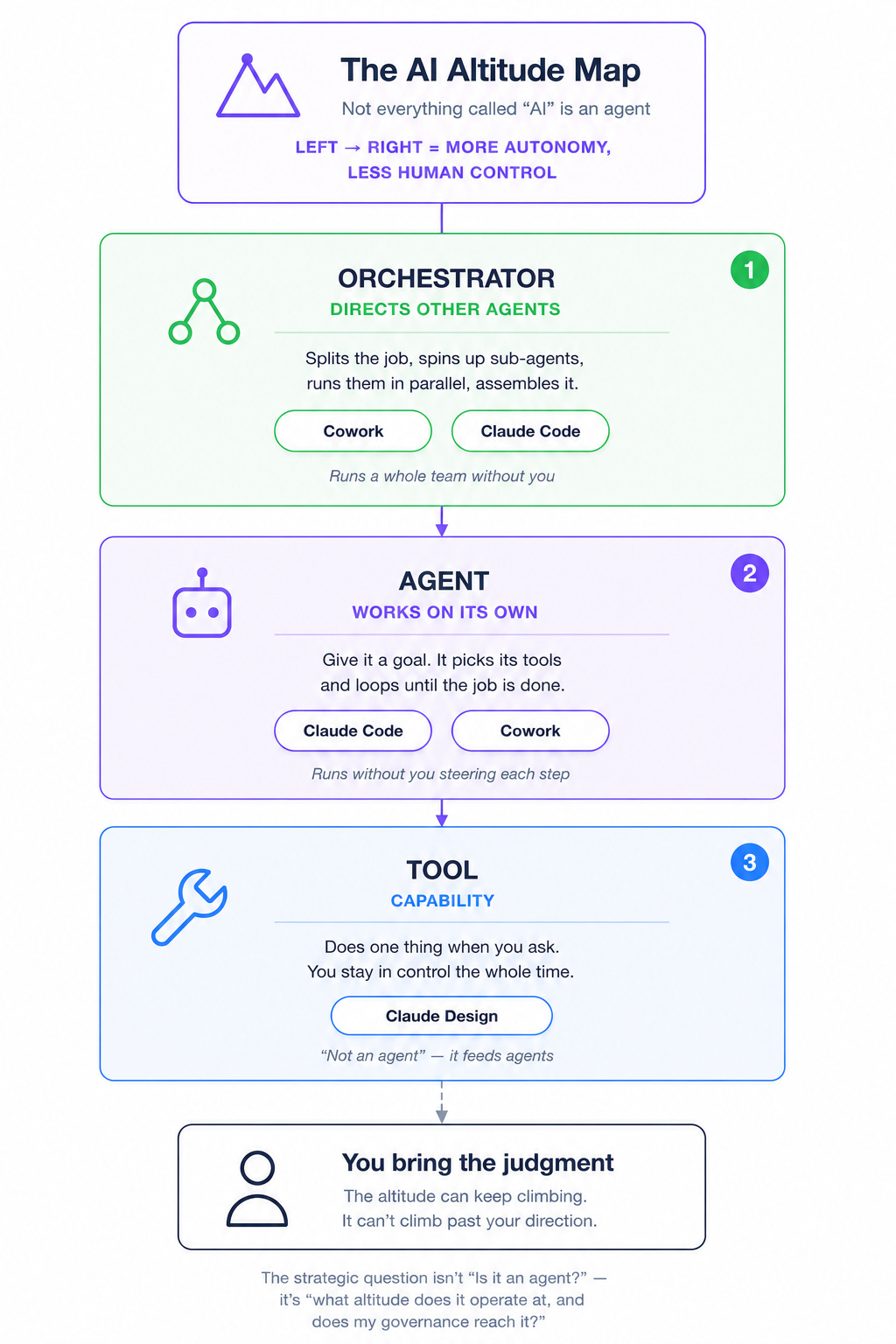
The altitude map
Here’s a cleaner model. Forget “is it a person or not.” Think about altitude. Every AI product operates at one of three heights, and the higher it flies, the less you’re touching the controls.
At the lowest altitude is a tool — a capability that does one thing when you ask, then waits. You’re the pilot the whole time. Anthropic’s Claude Design is a good example; the company describes it plainly as “not an agent.” It helps you create, then hands the work off.
At the middle altitude is the agent — it takes a goal and runs without you steering each step. Claude Code and Cowork both operate here: give them an objective and they navigate to it.
At the highest altitude is the orchestrator — an agent that spins up and directs other agents, breaking a big job into pieces and running them in parallel. Claude Code and Cowork climb to this height when the work demands it.
Notice what appears at none of those altitudes: a person. These are levels of automation, not degrees of humanity. An orchestrator running ten sub-agents is not “more of an employee” than a tool. It’s simply flying higher, with you further from the yoke.
The part the misconception gets wrong
Picture a newsroom. The stylebook is a tool you reach for. The reporter is an agent: hand them a beat, and they go work it. The editor is an orchestrator, assigning reporters and assembling the story. Useful roles, all of them. But none of them own the paper’s credibility. The publisher does.
That ownership is exactly what the synthetic-worker misconception leaves out. An agent can draft the press release, pull the data, and run the workflow at three in the morning. What it cannot do is carry the consequence when the release is wrong. It has no reputation to lose, no relationship to protect, no standing in the room when a stakeholder’s trust breaks. It cannot be sorry. It cannot be fired in any way that matters. Accountability doesn’t transfer to software just because the software got good.
This is why “how can we get agents to replace human workers?” is the wrong question, and a slightly dangerous one. It invites you to measure the technology against a person and then, quietly, to offload a person’s responsibilities onto it. The right questions are colder and far more useful: what is this agent allowed to do on its own, what does it hand back to a human, and who owns the outcome when it acts?
AI handles the volume. You bring the judgment. An agent can run the work; it can’t carry the consequence. Keep those two facts side by side and the “synthetic employee” dissolves back into what it always was: a very capable system that runs on its own, pointed at a goal you set, accountable to a human who never actually left the room.
So the next time someone on your team says “the agent will handle it,” ask the question that cuts through the misconception: handle what, exactly, and whose name is on it when it does?